

11
MayDesigning a modular kitchen in Gurgaon is not just about aesthetics. It is a battle against the elements. We experience the brutal, dry 45-degree heat of May, followed immediately by the suffocating, heavy humidity of the August monsoons, wrapped in a persistent layer of urban dust. Cabinet finishes that survive beautifully in a temperate climate often warp, peel, or yellow here.
When comparing Acrylic and PU finishes for Gurgaon's fluctuating climate, PU (Polyurethane) offers superior moisture and heat resistance due to its seamless coating, while Acrylic provides an unmatched, highly reflective, scratch-resistant gloss. The best choice depends on whether your kitchen faces direct sunlight or heavy daily usage.
Here is the technical reality behind choosing the right shutter finish for your modular kitchen, from the factory floor to the final installation in your home.
What is an Acrylic Finish? (The High-Gloss Contender)
Acrylic is reflective. It is unapologetic.
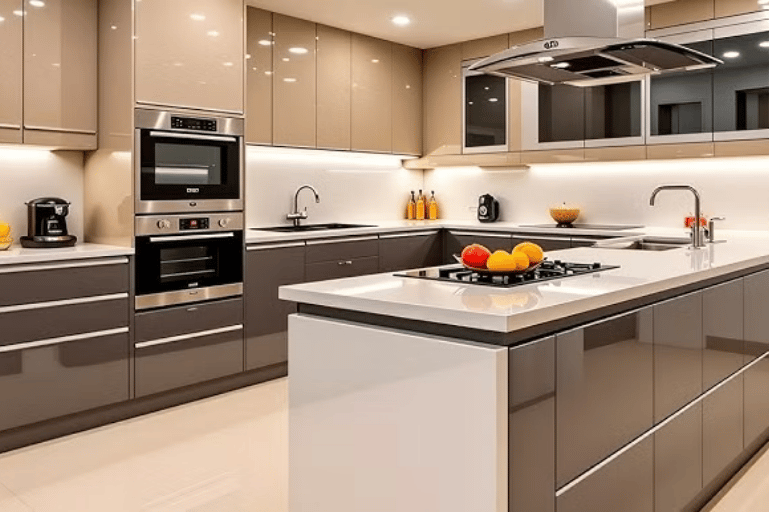
Run your hand across a premium acrylic shutter, and it feels like glass, yet it's shatterproof. Imagine a compact kitchen in an Emerald Estate apartment; the early morning sun hits these shutters, bouncing pure, un-refracted light across the room, instantly making a tight spatial footprint feel expansive. Technically speaking, acrylic is a non-toxic, highly reflective polymer sheet that is machine-pressed onto a core board, usually an HDHMR (High-Density High Moisture Resistance) or MDF base.
Because it is a sheet pasted onto a board, the edges must be sealed individually with edge banding.
The Advantages:
- Mirror-Like Reflection: Offers a pristine, glass-like gloss that remains unmatched by liquid paints.
- Colour Retention: UV-resistant properties mean a deep navy or stark white acrylic won't fade or yellow over years of indirect sunlight.
- Scratch Resistance: Highly durable against surface-level abrasions from daily cooking activities.
The Drawbacks:
- Fingerprint Magnet: The extreme gloss shows smudges instantly, requiring frequent wipe-downs in busy households.
- Edge-Banding Dependency: The longevity of the shutter is entirely dependent on the quality of the edge-banding glue; if moisture penetrates the seam, the board will swell.
What is a PU (Polyurethane) Finish? (The Seamless Protector)
PU is seamless. It is liquid armour.
Unlike acrylic sheets, PU sheets do not need to be pasted. It is sprayed. In our specialised, dust-free manufacturing zones, Polyurethane is applied as a liquid coating directly over the raw cabinetry board. It cures into a hard, monolithic shell that wraps around the front and edges of the shutter, with no joints.
The tactile experience of a matte PU finish is distinct. It absorbs light rather than reflecting it, offering a velvety, muted sophistication that feels incredibly grounded in large, open-plan villas.
The Advantages:
- 100% Seamless: No edge-banding means zero weak points for monsoon moisture to infiltrate the core board.
- Versatility: Available in extremely high-gloss or ultra-matte finishes, in literally any colour shade you can imagine.
- Repairability: Minor scratches on a PU surface can often be buffed out or seamlessly re-coated, unlike a torn acrylic sheet.
The Drawbacks:
- Manufacturing Time: The intensive process of spraying, sanding, and curing multiple coats in a temperature-controlled environment extends delivery timelines.
- Cost Factor: The heavy labour and specialised booth requirements make it a more premium investment compared to standard acrylic.
The Gurgaon Climate Test: Head-to-Head Comparison
How do these materials actually perform when subjected to the NCR's extreme environmental shifts?
|
Environmental Factor |
Acrylic Finish |
PU (Polyurethane) Finish |
The Winner |
|
Scorching Heat (40°C+) |
Holds colour well, but prolonged direct heat can rarely weaken edge-banding adhesives. |
Cures into a hard shell that resists ambient heat effectively without warping. |
PU Finish |
|
Monsoon Humidity |
Vulnerable at the microscopic seams if not factory-sealed with PUR glue. |
Completely impervious to surface moisture due to its seamless, wraparound nature. |
PU Finish |
|
Urban Dust & Maintenance |
Wipes clean easily, but extreme gloss highlights every speck of dust and fingerprint. |
Matte variants hide dust and smudges brilliantly, though gloss PU requires similar upkeep to acrylic. |
Tie (Depends on Finish) |
Why Factory-Made Precision Matters for Both
A material is only as good as the machinery that shapes it.
If you choose acrylic, the edge-banding must be applied using advanced edge-banding machines (like the German Homag systems) with heat-resistant PUR adhesives. Local carpenters using manual edge-taping will guarantee a peeling disaster within two monsoons. Similarly, PU must be sprayed in pressurised, dust-free chambers. A speck of dust landing on wet PU ruins the entire shutter. This is why working directly with established modular kitchen manufacturers in Gurgaon is critical; we remove the human error from the climate equation, ensuring absolute precision before the cabinetry ever reaches your site.
The Urban Design Co. Advantage: Engineered for the NCR Lifestyle
We don't just build kitchens. We engineer environments.
At Urban Design Co., our philosophy is rooted in absolute, unyielding precision. While traditional on-site carpentry struggles with manual edge-banding and humid, dust-filled spraying conditions, our 11,000 Sq. The Ft. manufacturing facility operates on a completely different frequency. We leverage state-of-the-art German machinery to ensure every millimetre of your chosen finish is mathematically perfect.
Because our expertise is hyper-focused strictly on premium modular kitchens, custom wardrobes, and sophisticated living room woodwork, our entire production ecosystem is optimised for cabinetry excellence. For clients seeking a true Luxury Modular Kitchen Gurgaon aesthetic, whether outfitting a compact apartment or an expansive estate, our design-to-installation process guarantees a climate-proof, flawless execution that elevates your daily living experience.
Conclusion: Which Should You Choose?
Choose Acrylic if you want a bold, ultra-modern, high-gloss statement kitchen that maximises light in a smaller space and you don't mind a quick daily wipe-down.
Choose PU if you are designing a sprawling, heavily used kitchen where long-term durability against extreme moisture is the absolute priority, or if you desire a highly customised, seamless matte aesthetic.
Frequently Asked Questions
Q1 Does an acrylic finish turn yellow over time?
Ans. High-quality, factory-pressed acrylic sheets are highly UV-resistant and do not turn yellow, even in kitchens with significant natural light. However, cheaper laminates masquerading as acrylic often discolour within a few years.
Q2 Is PU finish waterproof enough for heavy Indian cooking?
Ans. Yes. Because Polyurethane wraps the board seamlessly without any edge-banding joints, it creates an impenetrable barrier against steam, oil spills, and heavy monsoon moisture, making it ideal for intensive daily cooking.
Q3 Which is more expensive: Acrylic or PU kitchen cabinets?
Ans. PU finishes are generally more expensive than Acrylic. The higher cost is driven by the labour-intensive manufacturing process, which requires multiple rounds of spraying, sanding, and curing in specialised dust-free booths.
Q4 Which is more scratch-resistant: Acrylic or PU finish?
Ans. Acrylic sheets are inherently more resistant to daily surface scratches and abrasions. However, while high-gloss PU can show microscratches over time, it offers the unique advantage of easily buffing out or seamlessly recoating to look brand new.
Q5 Are acrylic kitchen cabinets completely waterproof?
Ans. The acrylic surface itself is 100% waterproof, but the overall shutter is only as water-resistant as its edge-banding. If the edges are not sealed with factory-grade PUR adhesives, moisture can eventually seep into the core board, causing swelling.